
What Are the Best Shower Timer Alternatives for Apartment Complexes?
Last Updated: October 26, 2026
Quick Summary
Shower timer alternatives apartment managers can deploy include battery-powered units starting at $250, plug-in standard units at $260, and commercial-grade brass valve units at $320. Each option reduces water consumption by cutting average shower duration by 3-5 minutes per unit, delivering measurable savings on water, sewer, and heating costs across multi-unit properties.
- A single 10-minute shower uses roughly 25 gallons; across a 40-unit complex, unrestricted usage adds thousands of dollars monthly to water and sewer costs.
- Battery-powered units require no wiring but need battery replacement every 12-13 months across all units.
- Plug-in standard units eliminate battery maintenance and cost only $10 more than battery models.
- Commercial brass valve units cost $320 and withstand heavy daily use better than plastic valves in high-turnover properties.
- Tenant buy-in increases when managers explain actual cost savings and frame timers as fairness mechanisms rather than punishments.
Table of Contents
- Why Apartment Complexes Need Shower Timer Solutions
- Shower Timers for Apartment Buildings: Core Features That Matter
- Comparison of Shower Timer Options for Rental Properties
- How to Explain Shower Time Limits to Tenants
- Tenant Water Conservation Tips for Shorter Showers
- Installation and Maintenance Considerations for Apartment Complexes
- Getting Started with a Shower Timer for Your Complex
- Frequently Asked Questions
Why Apartment Complexes Need Shower Timer Solutions
Water consumption in multi-unit buildings is one of the largest controllable utility expenses property managers face. When tenants don't pay their own water bills, the incentive to conserve disappears.
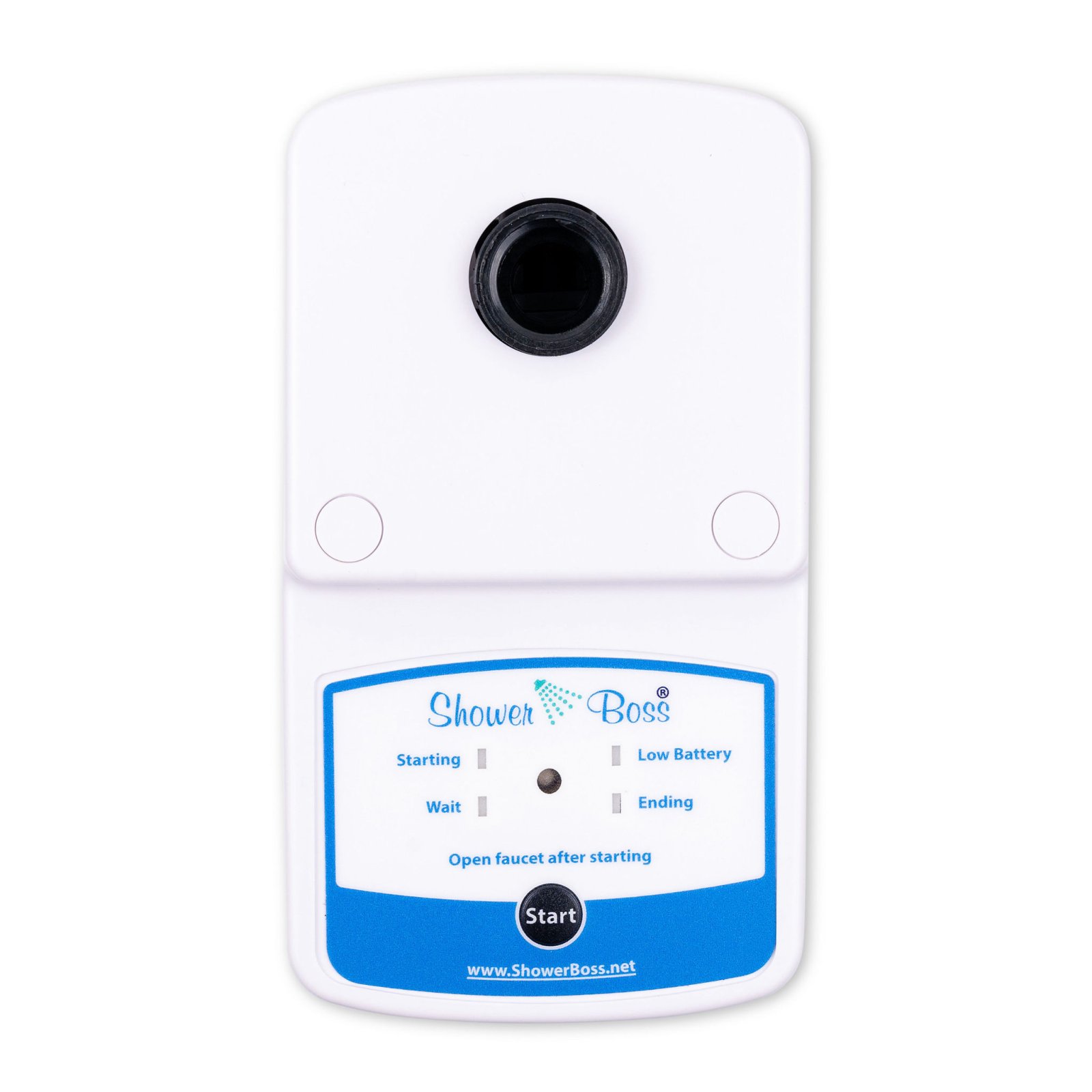
At ShowerBoss®, we understand the challenges apartment operators face. Tenants resist conservation when they perceive no personal benefit, and traditional approaches, signs, notices, appeals to environmental values, rarely produce measurable results. Shower timers solve this by creating a physical boundary that applies equally to every resident, 24/7.
The real value is the cumulative effect across dozens or hundreds of units, month after month. A shower timer alternative that cuts average shower duration by just 2-3 minutes per unit can meaningfully reduce your water bill and the energy costs of heating that water.
Shower Timers for Apartment Buildings: Core Features That Matter
When evaluating shower timer alternatives apartment dwellers and managers face, focus on features that address multi-unit realities. Not all timers perform equally in high-traffic environments with diverse users.
Power source reliability determines whether your system works consistently. Battery-powered units offer installation flexibility but require ongoing battery replacement across many units. Plug-in supplies eliminate battery concerns but need outlets near shower fixtures.
Durability in shared environments matters more than in single-family homes.
Adjustability and override capability prevent complaints and emergencies. A fixed 5-minute timer works for most showers but creates problems for elderly residents, people with mobility challenges, or specific hygiene needs.
Installation requirements affect deployment across the complex. Some alternatives require access to plumbing behind shower walls, demanding professional installation and risking water damage. Others mount externally with no permanent modifications, a major advantage for rental properties where fixtures may need removal or replacement.
Comparison of Shower Timer Options for Rental Properties
Your complex has several shower timer alternatives, each with distinct tradeoffs for cost, durability, and ease of deployment.
Battery-Powered Units: No Wiring Required
The ShowerTimer Battery unit 9V is the most straightforward entry point for properties testing shower conservation. It runs on six AA batteries with no hardwiring, so installation requires no electrician and no permanent bathroom modifications.

At $250 per unit, the battery model is the lowest upfront cost option. Installation takes minutes: mount, insert batteries, set the timer.
The primary limitation is battery maintenance: across a 40-unit complex, you're managing replacement schedules for 40+ devices.
Best for: Properties wanting to pilot shower timers with minimal upfront investment, buildings where access to electrical outlets near showers is limited, or complexes planning to test tenant acceptance before larger commitments.
Skip if: You need set-and-forget reliability without ongoing battery management, or you're managing large complexes where battery replacement becomes a logistical burden.
Plug-In Power Units: Consistent Performance
The ShowerTimer Standard Unit with 12V Plug-In Power Supply eliminates battery concerns entirely. A 12V plug-in adapter powers the device continuously, so once installed it needs no maintenance beyond occasional cleaning.

Priced at $260, it costs only $10 more than the battery model but delivers significantly different operation. The plug-in supply ensures the timer never fails due to dead batteries, and consistent power enables features like digital countdown displays that help tenants visualize remaining shower time.
Installation requires a standard electrical outlet near the shower, feasible in most apartment bathrooms, though some units may need an electrician to install one. The unit is ADA-accessible, which matters if your complex includes accessible units.
Best for: Standard apartment complexes with electrical outlets accessible near showers, properties wanting reliable operation without battery replacement cycles, or buildings managing 20+ units where consistent performance matters.
Skip if: Your bathrooms lack nearby electrical outlets and electrical installation costs would exceed the value of the timer, or if you need the absolute lowest upfront investment.
Commercial-Grade Brass Valve Units: Heavy-Duty Durability
The ShowerBoss® Standard Unit with Brass Solenoid Valve is engineered for commercial and multi-unit properties.

At $320, it carries a 23% premium over the standard plug-in unit, buying significantly greater durability.
The brass valve also provides a more decisive shutoff, tenants cannot continue showering by holding the valve open or manipulating the fixture. This enforcement matters in multi-unit properties where some residents test boundaries. The unit is ADA-accessible and designed for commercial installations.
Best for: Larger apartment complexes (30+ units), properties with high tenant turnover or younger resident populations, dorm facilities, or any setting where heavy daily use is expected. Commercial property managers wanting a long-term solution.
Skip if: You're managing a small building with careful tenants, or your budget is constrained and a standard unit meets your needs.
Option |
Starting Price |
Power Source |
Best For |
Installation |
|---|---|---|---|---|
Battery 9V Unit |
$250 |
6 AA batteries |
Pilot programs, low upfront cost |
No wiring needed |
Plug-In Standard Unit |
$260 |
12V adapter |
Standard apartments, reliable operation |
Requires outlet access |
Brass Valve Commercial Unit |
$320 |
12V adapter |
Large complexes, heavy-duty durability |
Requires outlet access |
How to Explain Shower Time Limits to Tenants
Tenant buy-in is the difference between a successful water conservation program and one that generates complaints. Tenants who understand the reason behind shower timers are far more likely to accept them as reasonable rather than punitive.
Start with transparency about costs. Many tenants don't realize water and sewer charges are a significant portion of utility expenses. Show actual numbers: "Our water bill for this building runs $X per month. That's $Y per unit.
Frame timers as a fairness mechanism, not a punishment. Residents who shower quickly subsidize those who shower long; a timer ensures everyone contributes equally.
Provide practical guidance on adapting to time limits. Five minutes feels short until you establish a routine.
Address accessibility concerns directly. Make clear that residents with mobility limitations, medical conditions, or other needs can contact management for accommodation, some shower timers allow manual override or adjustable settings.
Tenant Water Conservation Tips for Shorter Showers
Beyond the physical timer, tenant education amplifies water savings. When residents understand how their behavior affects building costs, they're more likely to adopt efficient shower habits voluntarily.
Low-flow showerheads reduce consumption without behavior change. A standard showerhead delivers 2.5 gallons per minute; low-flow alternatives deliver 1.5-2.0 while maintaining adequate pressure.
Temperature management reduces shower duration naturally. Cold water at the start of a shower encourages residents to minimize time. Once the system reaches steady state, water temperature stabilizes. This isn't punishment, it's physics.
Shower frequency awareness matters as much as duration. Encourage residents to evaluate whether daily showers are necessary.
Post visual reminders in bathrooms. A simple timer display showing remaining minutes makes the constraint visible and concrete. Residents who can see time passing tend to shower more efficiently than those who can't.
Installation and Maintenance Considerations for Apartment Complexes
Successful deployment of shower timers across an apartment complex requires planning beyond just purchasing units.
For battery-powered units, installation is straightforward enough that your maintenance staff can handle it without external help.
Plug-in units require electrical outlet access. If outlets don't exist near shower fixtures, you'll need an electrician to install them. This adds labor costs but happens once during installation. After that, maintenance is minimal.
For commercial-grade brass valve units, the installation process is identical to plug-in standard units from an electrical standpoint.
Document the installation date and timer settings for each unit. This record helps you track which units may need maintenance, plan battery replacement schedules, and troubleshoot tenant complaints.
Tenant communication before installation prevents complaints. Send a notice explaining what's being installed, why, and how it works. Include information about contacting management if they have concerns or accessibility needs.
Getting Started with a Shower Timer for Your Complex
The decision to implement shower timers should account for your specific property characteristics, tenant demographics, and budget constraints. Start by auditing your current water usage and costs. Contact your water utility for historical consumption data.
Identify which buildings or units would benefit most from timers. High-turnover properties with younger residents typically see the greatest water waste and the best response to timers. Smaller buildings with careful, long-term residents may see less dramatic savings. Prioritize high-impact areas first.
Consider a pilot program in one building before deploying across your entire complex. This approach lets you test tenant acceptance, identify installation challenges, and measure actual water savings before committing significant capital. A pilot also gives you time to refine tenant communication and establish maintenance routines.
ShowerBoss® offers shower timer solutions designed specifically for multi-unit properties. Whether you choose the battery-powered unit for flexibility, the plug-in standard unit for reliability, or the commercial-grade brass valve unit for heavy-duty durability, each option delivers measurable water and energy savings. Installing shower timers without professional help is possible with our straightforward setup process, and our team provides helpful ideas with custom installation needs to ensure your deployment goes smoothly.
For property managers serious about reducing utility costs and promoting sustainable water use, shower timers represent one of the highest-impact, fastest-payback improvements available.
Frequently Asked Questions
What are the best alternatives to ShowerCanary for apartment complexes?
Programmable shower timers like ShowerBoss® units offer renter-friendly alternatives that don't require permanent plumbing changes. Battery-powered models cost $250 and need no wiring, while plug-in units ($260–$320) provide consistent power without battery replacement. For apartment complexes, the key is choosing a unit that tenants can't easily disable, offers adjustable time limits, and works with existing shower fixtures. ShowerBoss® models are designed specifically for rental properties and multi-family buildings.
How can apartment managers reduce shower water use without replacing shower fixtures?
Shower timers are the most practical solution for existing fixtures. They mount directly to the wall or showerhead and limit water flow after a set duration—typically 5 to 8 minutes. Battery-powered timers require no installation access to plumbing and can be installed in minutes. Plug-in models offer reliable operation for high-traffic facilities like dormitories and apartment complexes. Combined with tenant education about water conservation, timers can significantly reduce shower water usage without renovation.
Are shower timers practical for multifamily properties?
Yes. Shower timers are highly practical for multifamily properties because they work independently at each fixture, require minimal installation, and don't depend on tenant cooperation or behavior change alone. Units designed for rental properties—like ShowerBoss® models with heavy-duty brass valves ($320)—withstand frequent use and accidental mishandling. Property managers report reduced water and energy bills within the first month. The upfront cost per unit ($250–$320) typically pays for itself through utility savings.
How can you explain shower time limits to tenants?
Frame shower timers as a shared responsibility, not a punishment. Explain that shorter showers reduce the complex's water and energy costs, which benefits everyone through lower utility overhead and more sustainable operations. Emphasize comfort: most timers allow 5–8 minutes, which is sufficient for a full shower. Highlight the environmental impact and show tenants the projected savings on utility bills if applicable. Provide clear signage in bathrooms explaining how to use the timer and what the time limit is. Address concerns about water pressure upfront—modern timers maintain adequate flow.
What should property managers compare when choosing shower timers?
Compare installation requirements (battery vs. plug-in power), durability for high-traffic use, adjustable time settings, water pressure maintenance, and cost per unit. Battery-powered units ($250) suit properties without easy access to electrical outlets, while plug-in models ($260–$320) work better in permanent installations. For commercial or heavy-use facilities, brass valve units offer superior durability. Check whether the unit is ADA-accessible and compatible with your existing showerhead or valve type. Request installation instructions upfront to confirm your maintenance team can handle setup.
Controlling water consumption in apartment complexes requires both systems and tenant cooperation. Shower timers create the system; clear communication and fair implementation build the cooperation. When residents understand that timers apply equally to everyone and that savings directly benefit the building community, resistance diminishes and compliance improves. Start with one building, measure your results, and expand from there. The data will guide your next steps.
