
5 Best Water-Saving Shower Timers for 2026
Last Updated: October 25, 2026
Quick Summary
Water-saving shower timers limit flow or shut off water after a preset duration, preventing users from letting water run unnecessarily and reducing both water consumption and energy costs tied to hot water heating. These devices range from mechanical dial timers at $10-$25 to commercial-grade automatic shutoff valves at $80-$350+, with alert-only timers best for cooperative users and automatic shutoff valves required where duration must be guaranteed.
- Mechanical and digital countdown timers cost $10-$40 and work via audible or visual alerts; automatic shutoff valves cost $80-$350+ and enforce limits without user action.
- A 2.0 gpm showerhead with an 8-minute timer uses about 16 gallons per shower; reducing to 5 minutes saves about 6 gallons per shower.
- Battery timers need annual or less frequent replacement; plug-in units avoid battery maintenance but require a nearby outlet.
- A 20-person facility saving 8 gallons per shower can reduce utility costs by roughly $580 per year at typical municipal rates.
- Pair any timer type with a WaterSense-labeled showerhead at 2.0 gpm or less to maximize water and energy savings.
Table of Contents
- Why Water-Saving Shower Timers Matter for Your Facility
- Quick Comparison: Water-Saving Shower Timer Options
- 1. ShowerTimer Battery Unit 9V: No-Wiring Installation
- 2. ShowerTimer Residential Unit: Plug-In Power for Families
- 3. ShowerTimer Standard Unit: ADA-Accessible for Shared Spaces
- 4. Standard Battery Unit: New Construction and Remodels
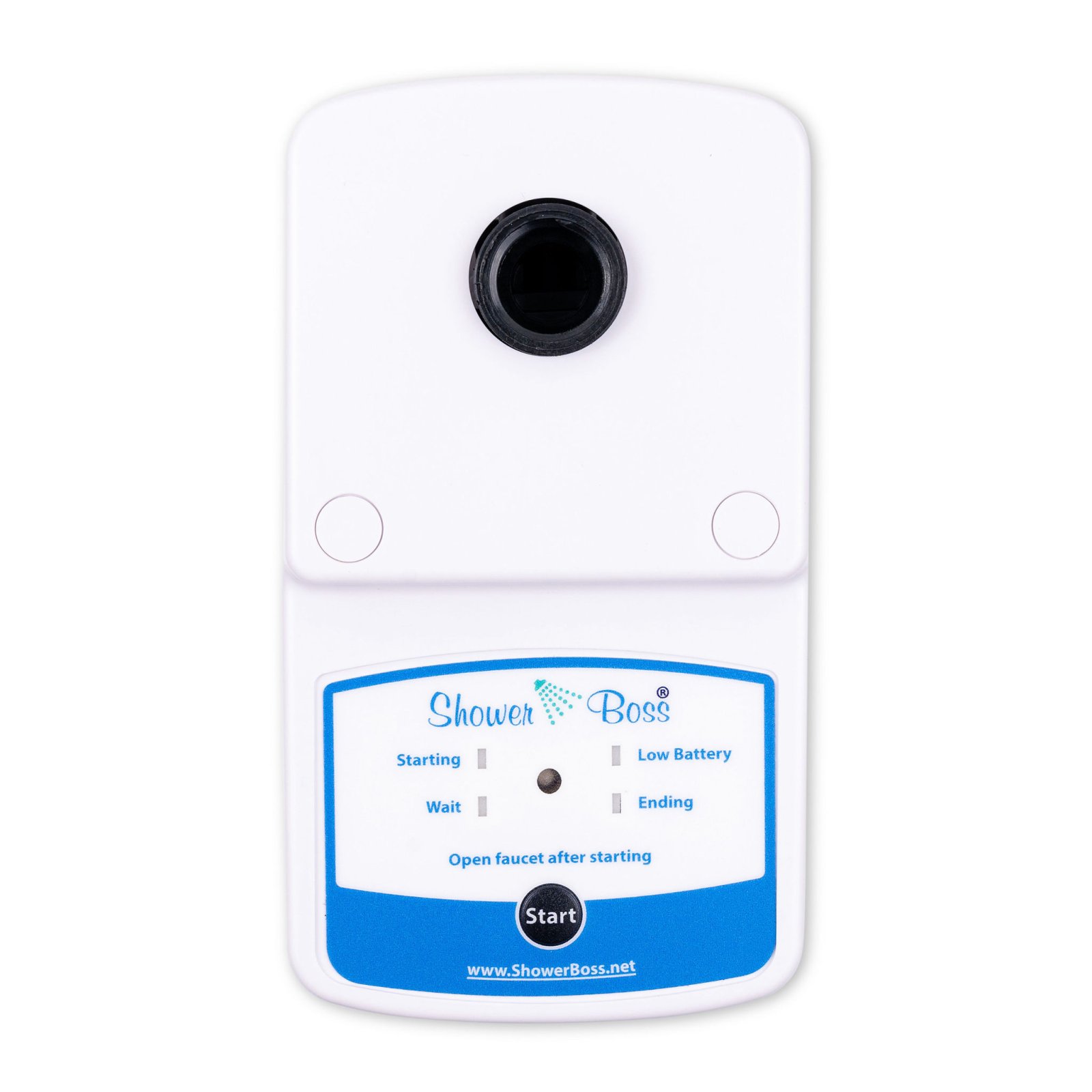
- 5. ShowerBoss Standard Unit with Brass Valve: Commercial-Grade Performance
- How a Programmable Shower Timer Works and Saves Water
- Frequently Asked Questions
Why Water-Saving Shower Timers Matter for Your Facility
Reducing water consumption is no longer optional for property managers, facility administrators, and business owners.
Water-saving shower timers limit flow or shut off water after a preset duration.
What makes water-saving shower timers effective is passive enforcement. Unlike signs or reminders, a timer removes the decision-making: when time runs out, the water stops or the user gets a visual or audible alert.
These devices also cut energy costs tied to hot water heating, every unnecessary minute means unnecessary energy consumption. Facilities deploying water-saving shower timers can achieve measurable reductions in water and utility bills.
Quick Comparison: Water-Saving Shower Timer Options
The table below spans the full timer category, from a few-dollar mechanical dial to a plumbed automatic shutoff valve, so you can compare like with like.
| Timer Type | Typical Price (USD) | Power Source | Installation | Savings Lever | Best For |
|---|---|---|---|---|---|
| Mechanical dial timer | $10-$25 | None (spring-wound) | Adhesive or one screw | Shortens duration via alert | Rentals, campgrounds, low-traffic showers |
| Digital countdown timer | $15-$40 | AA/AAA batteries | Adhesive or screw mount | Audible/visual alert; user self-limits | Households, dorms, gyms |
| Visual-only timer (sand/LED) | $10-$30 | None or battery | Adhesive mount | Visual cue only | Homes, quiet facilities |
| In-line automatic shutoff valve | $80-$200 | Battery or low-voltage | Plumbing access required | Hard stop at set duration | Commercial showers, high-traffic facilities |
| Valve-replacement shutoff unit | $250-$350+ | 12V plug-in or battery | Licensed plumber often required | Hard stop plus tamper-resistant settings | New construction, ADA-accessible facilities |
How to read the table. For behavior change on a budget, a mechanical or digital countdown timer delivers most of the benefit at a fraction of the cost, if users cooperate.
Flow rate context. The timer sets duration; the showerhead sets gallons per minute. Federal standards cap new showerheads at 2.5 gpm, and WaterSense models use 2.0 gpm or less.
Power and maintenance. Battery timers need periodic replacement (often annually or less); plug-in and hardwired units avoid that but require an outlet or electrician. Factor maintenance labor into total cost, not just purchase price.
Installation and compatibility. Adhesive-mounted timers fit nearly any shower wall but may not survive repeated wet cycles on textured surfaces. If you have custom installation needs or want guidance on which timer type suits your facility's layout and code requirements, helpful ideas with custom installation needs are available to help you plan the right approach.
1. ShowerTimer Battery Unit 9V: No-Wiring Installation
The ShowerTimer Battery Unit 9V is the simplest entry point for facilities needing quick deployment without electrical work. Powered by 6 AA batteries, it requires no hardwiring, ideal for rental properties, temporary installations, or sites where running power lines isn't practical.
Adjustable timer settings let you customize shower duration to your facility's needs, and the straightforward interface works for all age groups. The trade-off: no digital countdown display, users get only an audible alert when time is running out.
Battery replacement occurs annually or less frequently depending on usage patterns. You can purchase the ShowerTimer Battery unit 9V directly for immediate deployment.

Best for: Small properties, temporary installations, facilities without nearby power outlets.
Skip if: You need a digital countdown display or prefer not to manage battery replacements.
2. ShowerTimer Residential Unit: Plug-In Power for Families
The ShowerTimer Residential Unit combines reliable plug-in power with a user-friendly design for households and small shared accommodations. Its 12V plug-in adapter delivers consistent performance without ongoing battery maintenance.
It comes with a nylon valve. The intuitive interface means tenants understand it immediately, and the 12V plug-in supply keeps it running reliably year-round, a solid choice for rental complexes managing water costs across multiple units.
This ShowerTimer unit is great for families and other settings where the users are known. You can buy the ShowerTimer Residential Unit to start controlling shower duration across your property.

Best for: Rental properties, family homes, small dormitories, facilities with stable user populations.
Skip if: You need commercial-grade durability or have frequent high-turnover users who may misuse the equipment.
3. ShowerTimer Standard Unit: ADA-Accessible for Shared Spaces
The ShowerTimer Standard Unit is purpose-built for new construction and remodeling where ADA accessibility is required. It meets handicap accessibility standards, making it compliant for college dorms, public facilities, and any shared space subject to accessibility regulations.
Like the Residential Unit, it runs on a 12V plug-in supply for consistent, maintenance-free operation. It ships with a nylon valve, upgradable to heavy-duty brass for an added cost depending on water pressure and durability needs. The ADA-accessible design lets all users, regardless of mobility or height, operate it comfortably.
Get the ShowerTimer Standard Unit for facilities that need compliance and reliability in shared spaces.

Best for: New construction, ADA-compliant facilities, college dorms, public showers, remodeling projects.
Skip if: You're retrofitting existing showers in older buildings where wall access is limited.
4. Standard Battery Unit: New Construction and Remodels
The Standard Battery Unit offers flexibility for new construction and remodeling where you have access to the back of the shower wall. Battery power eliminates 12V wiring, simplifying installation in renovations.
It runs on batteries like the ShowerTimer Battery Unit 9V, giving installation freedom without electrical work, and it's ADA-accessible for facilities requiring handicap compliance. It's especially useful in remodels where running new power lines would add cost and complexity.
Battery maintenance is minimal, typically annual replacement depending on usage. You can order the Standard Battery Unit for straightforward deployment in renovation or new construction.
Best for: Remodeling projects, new construction with wall access, facilities avoiding electrical installation.
Skip if: You prefer plug-in power or manage high-volume shower facilities where battery replacement becomes a burden.
5. ShowerBoss Standard Unit with Brass Valve: Commercial-Grade Performance
The ShowerBoss Standard Unit with Brass Valve is the premium option for commercial and high-volume environments. Its heavy-duty brass solenoid valve handles frequent use in gyms, campgrounds, RV parks, and commercial showers without performance degradation.
It includes a 12V plug-in power supply and brass valve, eliminating upgrades. The automatic shutoff performs reliably under demanding conditions.
The ShowerBoss Standard Unit is ADA-accessible and designed for new construction and commercial remodeling. Its commercial-grade engineering suits facilities that cannot afford downtime or frequent maintenance. Purchase the ShowerBoss Standard Unit with Brass Valve for commercial-scale water conservation.
Best for: Gyms, campgrounds, RV parks, college dormitories, commercial facilities with high shower traffic.
Skip if: You're managing a small residential property where the nylon valve option provides adequate durability.
How a Programmable Shower Timer Works and Saves Water
A programmable shower timer is a distinct category, and the common types behave very differently in a shared bathroom.
Mechanical timers. A spring-wound or twist dial counts down from a set interval (commonly 5, 8, or 10 minutes) and sounds a bell or buzzer at zero. No batteries or wiring, adhesive or single-screw mounting, lowest cost. Accuracy drifts with spring wear and there's no display beyond the dial, best for low-traffic rentals and campgrounds where simplicity beats precision.
Digital countdown timers. A battery-powered LCD shows remaining time and beeps or flashes at preset intervals; buttons set minutes and seconds, and many remember the last setting.
Visual-only timers. A sand hourglass, color-changing disc, or shrinking LED ring with no audible alert.
How the savings actually work. A timer does not change flow rate; it changes duration. The math is straightforward:
- Water saved per shower = (baseline minutes − timed minutes) × flow rate in gallons per minute (gpm).
- A standard showerhead is capped at 2.5 gpm under federal efficiency rules; WaterSense-labeled models are 2.0 gpm or less.
- Example: a 10-minute baseline trimmed to 6 minutes at 2.0 gpm saves 8 gallons per shower.
- Multiply by showers per day and occupants to get daily savings, then by your utility's per-gallon rate (water plus sewer) for a dollar figure.
A 20-person facility averaging one shower per day and saving 8 gallons each cuts roughly 160 gallons daily. At a combined water-and-sewer rate of about one cent per gallon, a common order of magnitude in many U.S. municipalities, that is on the order of $1.60 per day, or roughly $580 per year, before any hot-water energy savings. Actual results depend on baseline shower length, flow rate, occupancy, and local rates.
Accuracy, setup, and usability. Timing accuracy matters more for automatic shutoff than alert-only timers.
Power and bathroom suitability. Battery units avoid wiring but add maintenance; plug-in units need a nearby outlet and low-voltage adapter; hardwired automatic valves need an electrician.
Frequently Asked Questions
Do water-saving shower timers actually save water?
Yes. Water-saving shower timers reduce shower duration by enforcing preset time limits, typically 5-10 minutes. Since the average shower uses 2.5 gallons per minute, a timer that cuts shower time from 10 to 6 minutes saves 10 gallons per shower. For a facility with 40 units showering daily, that's 400 gallons saved per day, or roughly 146,000 gallons annually. Property managers and campground operators report 20-30% reductions in water consumption after installing timers.
How do programmable shower timers work?
A programmable shower timer controls water flow using a solenoid valve that opens and closes based on a preset countdown. When a user starts the shower, the timer begins counting down. At the end of the set duration, the valve automatically shuts off water flow, stopping the shower. Some models include visual or audible alerts at the midpoint or final minute to warn users. Battery-powered units operate independently without hardwiring; plug-in models draw power from a 12V adapter for continuous, uninterrupted operation.
How long should a water-saving shower last?
The EPA recommends showers last no more than 5 minutes. However, most facilities set timers between 6-10 minutes to balance water savings with user comfort and compliance. Residential households often prefer 8-10 minutes, while commercial facilities managing high-volume usage (dorms, gyms, campgrounds) may enforce stricter 5-7 minute limits. Programmable timers let you adjust the ideal shower length based on your facility type and water conservation goals.
Are shower timers easy to install without professional help?
Battery-powered models like the ShowerTimer Battery Unit 9V require no wiring and can be installed in minutes by a maintenance staff member. Plug-in models such as the ShowerTimer Residential Unit or Standard Unit need access to a 12V power outlet but still avoid the need for professional plumbing. Both types connect to existing shower plumbing via a solenoid valve. Rental properties, dorms, and campgrounds typically manage installation in-house. ADA-accessible models are designed for straightforward setup in shared bathrooms.
Are shower timers suitable for rental properties and shared bathrooms?
Yes. Rental properties, dorms, and shared facilities benefit most from shower timers because they reduce water waste when tenants or residents have no direct incentive to conserve. Timers enforce conservation automatically, eliminating the need to rely on occupant behavior. Many property managers report that timers reduce tenant complaints about water bills and lower overall utility overhead. ADA-accessible models ensure compliance with accessibility requirements, and durable construction withstands heavy use in high-traffic bathrooms.
