
Average Water Savings in Campground Showers (2026)
Table of Contents
- How Much Water Campground Showers Actually Save
- Shower Water Use Per Minute: The Number Behind Every Savings Estimate
- How to Calculate Shower Water Savings at Your Facility
- Separate Estimates by Showerhead Flow Rate and Shower Duration
- Water-Saving Shower Timers: Turning Estimates Into Behavior Change
- Campground Water Conservation Tips That Hold Up in Real Use
- When to Use Campground Facilities Instead of the RV Shower
- Conclusion
- Frequently Asked Questions
Last Updated: October 19, 2026
How Much Water Campground Showers Actually Save
Campground showers typically use less water than RV showers, and the gap is bigger than most campers expect. Showering is one of the largest water draws at any campground or RV park, and at ShowerBoss®, we help operators measure and control that draw with programmable shower timers.
There is no single official figure for average water savings in campground showers. Savings depend on flow rate, shower length, and what the camper would have used instead, but you can estimate them with a simple formula, and most estimates land in a useful range.
The 3 factors that decide your savings:
- Flow rate of the showerhead, in gallons per minute
- Shower duration, in minutes
- Baseline, meaning what the camper would have done without your facilities
Get those three right and the math takes care of itself. Below, we walk through each one and show you how to run the numbers for your own site.
Shower Water Use Per Minute: The Number Behind Every Savings Estimate
Shower water use per minute is the flow rate of the showerhead in gallons per minute (GPM). It drives every savings estimate, because total water use is just flow rate multiplied by minutes, get it wrong and every downstream calculation is wrong with it.
Flow rates vary widely by fixture type. Older showerheads can run well above modern limits, while newer low-flow models sit at the lower end. The U.S.
Flow Rate Benchmarks by Showerhead Type
| Showerhead Type | Typical Flow Rate | Notes |
|---|---|---|
| Older standard head (pre-1990s) | 3.0-5.0 GPM | Common in aging bathhouses; highest savings opportunity |
| Standard head (1990s-2000s) | 2.5 GPM | The federal maximum before WaterSense |
| WaterSense-labeled low-flow | 2.0 GPM or below | Best baseline for estimates; labeled maximum is 2.0 GPM |
| High-efficiency low-flow | 1.5-1.8 GPM | Growing share of new installations |
| Handheld showerhead | 1.5-2.5 GPM | Varies by model; popular in campground stalls |
| RV factory showerhead | 1.5-2.0 GPM | Built for tank limits; often an oxygenics-style head |
A common mistake is estimating savings from the flow rate printed on the box. Real flow depends on water pressure: a 2.0 GPM head at 40 psi may deliver closer to 1.4 GPM, while the same head at 80 psi delivers its rated 2.0 GPM. Check the actual fixture in the stall before you trust any label.
Why the Baseline Matters More Than the Fixture
The savings number is only meaningful relative to a baseline. Against an RV head (typically 1.5-2.0 GPM) the same campground shower can look like a big saver; against a residential head (2.0-2.5 GPM) it can look like a wash.
For most campground operators, the useful baseline is the RV shower, since that is the realistic alternative for campers on site, and it is the comparison behind the question of how much water a camper saves by walking to the bathhouse instead of showering in the rig.
How to Calculate Shower Water Savings at Your Facility
To calculate shower water savings, multiply flow rate by shower duration to get gallons per shower, then multiply by the number of showers and compare against your baseline.
The formula:
Gallons per shower = Flow rate (GPM) × Shower duration (minutes)
Total use = Gallons per shower × Showers per period
Savings = Baseline use − Current use
Run it once per fixture type, averaging mixed showerheads hides the problem stalls.
A Worked Example: 500 Showers a Week
Say a campground runs 500 showers a week. Each shower averages 6 minutes. The stall showerheads flow at 2.0 gallons per minute.
- Gallons per shower: 2.0 × 6 = 12 gallons
- Weekly use: 12 × 500 = 6,000 gallons
- If timers cut the average shower to 4 minutes: 2.0 × 4 = 8 gallons
That is a one-third cut from behavior change alone, with no fixture replacement, which is why the math is worth doing before you buy anything.
Separate Estimates by Showerhead Flow Rate and Shower Duration
Split savings estimates by flow rate and duration, because the two interact: a low-flow head with a long shower can use more water than a higher-flow head with a short one.
Use this grid to estimate gallons per shower at common combinations:
| Flow Rate | 4 Minutes | 6 Minutes | 8 Minutes |
|---|---|---|---|
| 1.5 GPM | 6 gal | 9 gal | 12 gal |
| 2.0 GPM | 8 gal | 12 gal | 16 gal |
| 2.5 GPM | 10 gal | 15 gal | 20 gal |
Duration moves the number as much as flow rate does, and the worst case in the grid uses more than three times the water of the best, which is why fixture audits and time limits work best together.
Water-Saving Shower Timers: Turning Estimates Into Behavior Change
Water-saving shower timers convert an estimate into an actual reduction by capping shower length. A visible countdown makes the limit clear and consistent instead of depending on goodwill.
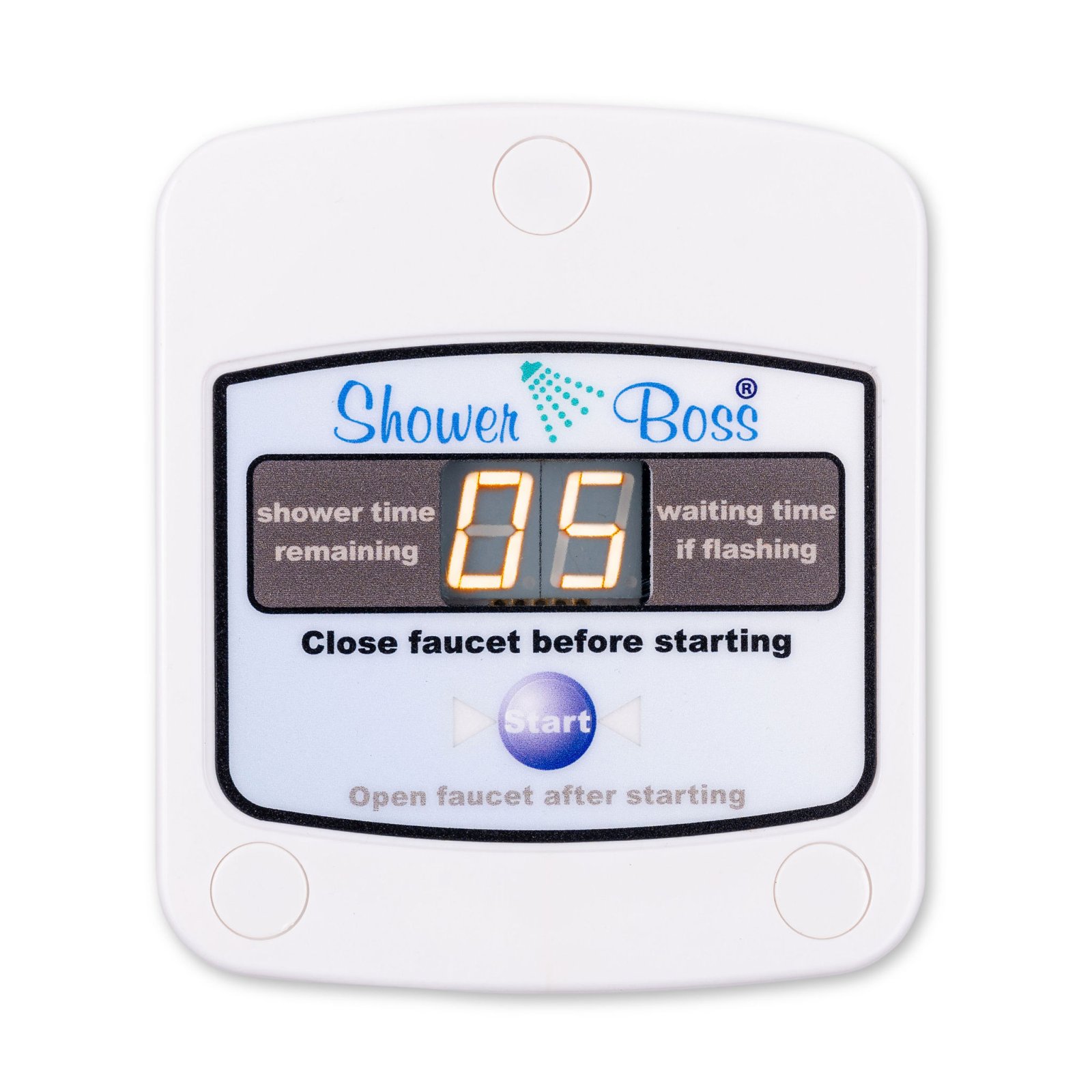
This is where most conservation plans stall. Operators post a sign asking for shorter showers, and nothing changes. A timer changes the default.
Our ShowerTimer units are built for exactly this setting. The ShowerTimer Standard Unit with 12V Plug-In Power Supply is designed for new construction and remodeling and is handicap accessible for ADA requirements. For bathhouses without power at the stall, the ShowerTimer Battery Unit 9V installs without wiring.
ShowerTimer Standard Unit / with 12V Plug-In Power Supply →


Campground Water Conservation Tips That Hold Up in Real Use
Campground water conservation works best when you combine three levers: fixture efficiency, time limits, and camper awareness. Any one alone leaves savings on the table.
What actually holds up in practice:
- Set a clear shower time limit and post it where campers see it before undressing
- Audit every showerhead and replace the high-flow outliers first
- Fix leaks immediately, since a dripping valve runs all day
The wet-soap-rinse technique and the navy shower are the same idea: water runs only when it is doing work. Campers who adopt either habit cut their shower time without feeling rushed.
Beyond the Shower: Water Use Most Operators Overlook
Shower savings are only part of the picture. Water use beyond the shower itself adds up fast at any campground.
Watch these draws:
- Dishwashing stations, where taps often run unattended
- Toilet flushing, a steady baseline draw all day
- Laundry facilities, if you offer them
Track these separately; attributing all water use to showers overstates what timers can deliver.
When to Use Campground Facilities Instead of the RV Shower
Use campground facilities when your RV freshwater tank is low, your wastewater tank is near full, or you are dry camping with no hookups, the campground shower saves tank capacity for drinking and cooking. It is also a measurable water-savings decision, and you can run the numbers before you choose.
The Campground-versus-RV Savings Calculation
The savings from choosing the campground shower is the difference between what the RV shower would have used and what the campground shower actually uses, multiplied by the number of showers.
Savings per shower = (RV flow rate × RV shower minutes) − (Campground flow rate × Campground shower minutes)
Trip savings = Savings per shower × Showers per trip
A Scenario Table: Three Setups, Three Savings Figures
Assume a 4-person travel party, one shower per person per day, and a 3-day trip (12 showers total). The RV shower is the baseline in every row.
| Setup | RV Shower (Baseline) | Campground Shower | Savings per Shower | Trip Savings (12 showers) |
|---|---|---|---|---|
| Standard RV head vs. standard bathhouse head | 2.0 GPM × 8 min = 16 gal | 2.5 GPM × 6 min = 15 gal | 1 gal | 12 gal |
| Standard RV head vs. WaterSense bathhouse head | 2.0 GPM × 8 min = 16 gal | 2.0 GPM × 5 min = 10 gal | 6 gal | 72 gal |
| Low-flow RV head vs. WaterSense bathhouse head with timer | 1.5 GPM × 8 min = 12 gal | 2.0 GPM × 4 min = 8 gal | 4 gal | 48 gal |
The counterintuitive result: a campground shower with a higher-flow head can still save water if the shower is shorter. Duration is the lever, and the biggest savings come when the bathhouse combines a WaterSense head with a time limit.
Water Use Beyond the Shower Itself
The showerhead is not the only draw. The RV shower also uses water to fill and heat the freshwater tank and consumes wastewater capacity: a 12-gallon shower adds roughly 12 gallons to the gray tank, so on a 40-gallon tank three RV showers can push a camper to a dump station a day early, a real cost in time and, at some parks, in dump fees.
There is also the hot-water wait: RV water heaters take time to recover, and campers often run the tap while waiting. A bathhouse with a recirculating hot-water loop avoids most of that waste; without one, the wait water is part of the true campground-shower draw and should be counted.
A Practical Decision Guide
Weigh these factors in order:
- Tank status: Freshwater under half or gray tank over half, use the campground shower.
- Trip length: Multi-day dry camping, use the campground shower for at least half the showers to stretch tank capacity.
- Shower length habit: If the camper tends to take long RV showers, the bathhouse timer is the bigger saver.
Convenience and space favor the RV; water capacity, tank life, and measurable savings favor the bathhouse. Most experienced campers use both depending on where they are in the trip, and those who track it find the bathhouse saves the most water on the longest trips.
Conclusion
Cutting shower water at a campground is a math problem first and a behavior problem second. Measure your flow rates, set a clear time limit, and the savings follow.
If you run a campground, RV park, or any shared shower facility, ShowerBoss® builds programmable timers that make those limits automatic. Our units are designed for both residential and commercial facilities, with plug-in and battery-powered options to fit your bathhouse.
Frequently Asked Questions
What is the average water consumption for a campground shower?
A typical campground shower runs 8 to 10 minutes at 2.0 to 2.5 gallons per minute, which works out to roughly 16 to 25 gallons per shower. Older unrestricted showerheads at 3.5 to 5 gallons per minute can push a single shower past 35 gallons. For planning purposes, many operators budget 20 gallons per camper shower, then adjust once they measure their own flow rate and average shower duration.
How much water can a campground save by shortening shower times?
Cutting an average shower from 10 minutes to 5 minutes at 2.0 gallons per minute saves about 10 gallons per shower. At 500 showers a week that is 5,000 gallons weekly, or roughly 260,000 gallons a year. Because the savings scale directly with flow rate and minutes removed, measure both before you set a target. A timer that enforces the shorter duration is what turns the estimate into an actual reduction.
How can campground operators measure shower water use?
Start with two measurements: flow rate and duration. Capture flow rate by running a shower into a marked bucket for exactly one minute, or by reading the gallons-per-minute rating stamped on the showerhead. For duration, time a sample of showers across a busy weekend and average them. Multiply the two numbers to get gallons per shower, then multiply by shower count. Repeat quarterly, since fixtures and camper behavior both drift.
Do low-flow showerheads reduce water use in campgrounds?
Yes, and the effect is larger than most operators expect because it applies to every shower, every day. Swapping a 2.5 gallons-per-minute head for a 1.8 gallons-per-minute model cuts water use by 28% at the same shower duration. Combine that with a shorter average shower and the two changes multiply rather than add. Confirm the replacement is rated for commercial use and check that pressure still feels adequate before rolling it out across every stall.