
How to Lower Water Heating Bills: 7 Proven Steps
Table of Contents
- How to Lower Water Heating Bills: Start With the Right Temperature Setting
- How to Reduce Hot Water Usage Without Sacrificing Comfort
- Low-Flow Showerhead Savings: What You Actually Save
- Water Heater Insulation Blanket and Pipe Insulation: Cut Heat Loss
- Smart Controls and Time-of-Use Rates: Advanced Ways to Lower Water Heating Bills
- Troubleshooting Unusually High Water Heating Bills
- Conclusion: Prioritize Your Water Heating Savings Plan
- Frequently Asked Questions
Last Updated: October 14, 2026
How to Lower Water Heating Bills: Start With the Right Temperature Setting
Water heating is one of the largest energy costs in most homes, and the fastest fix costs nothing.
The math is simple. Every 10°F you shave off the tank temperature cuts standby heat loss and the energy needed to reheat.
The water heater temperature setting to save energy sits at 120°F. That is the sweet spot for most homes.
A few things to know before you adjust:
- Mark the current setting first. Use a marker or tape so you can compare later.
- Wait a few hours for the tank to settle at the new temperature before you test it.
- Check at the tap, not the dial. A thermometer at the faucet tells you the real number.
- Go no lower than 120°F. Below that, you risk bacterial growth in the tank.
For homes with someone who is immunocompromised, keep the tank at 140°F and install a mixing valve at the outlet.
U.S. Department of Energy guidance on water heating
How to Reduce Hot Water Usage Without Sacrificing Comfort
The average shower uses more hot water than any other daily activity, so how to reduce hot water usage starts in the bathroom. You do not need cold showers or military-style discipline. You need a few small changes that most people barely notice.
Start here:
- Shorten showers to five minutes. A timer makes this automatic instead of a nagging reminder.
- Install a low-flow showerhead. Modern models feel strong at 2.0 gallons per minute or less.
- Fix leaky faucets. A steady drip wastes hot water around the clock.
- Run full loads only. Half-empty washers and dishwashers waste heat and water.
- Wash clothes in cold water. Most loads do not need hot water at all.
- Turn off the tap while shaving or brushing. Let it run only to rinse.
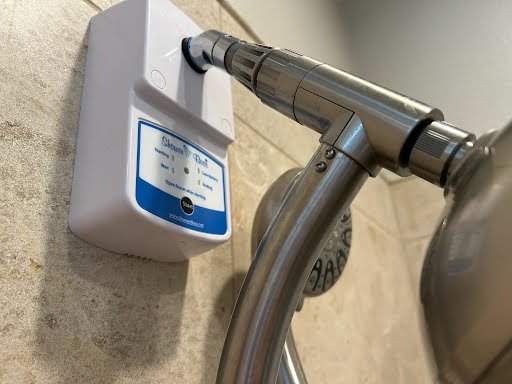
A close-up of a wall-mounted programmable Battery shower timer with a standard showerhead and a hand-held spray.
For property managers and campground operators, the challenge is different. Our ShowerTimer Standard Unit works for new construction and remodels, and the ShowerTimer Battery Unit 9V needs no wiring at all, which makes it a fit for older buildings where running power to the shower is a headache.


Low-Flow Showerhead Savings: What You Actually Save
Low-flow showerhead savings come down to one number: flow rate. A standard older head pushes 2.5 gallons per minute. A WaterSense-labeled model caps at 2.0 or lower. That gap adds up fast across every shower in the building, but the only way to know what it means for your bill is to run your own numbers.
Here is how to size the payoff:
Fixture Type |
Flow Rate |
Hot Water Used in a 10-Minute Shower |
|---|---|---|
Older standard head |
2.5 GPM |
25 gallons |
WaterSense low-flow |
2.0 GPM |
20 gallons |
High-efficiency low-flow |
1.5 GPM |
15 gallons |
Swapping one head cuts a 10-minute shower by 5 gallons or more. Multiply that by every shower, every day, and the water-heating load drops with it.
Turn Gallons Into Dollars
Most guides stop at the gallon count. The useful step is converting that to money, and the conversion depends on four things: how many people shower in your home, how long each shower runs, the flow rate of the head, and what you pay per unit of energy.
A workable estimate:
- Count daily shower-minutes. Four people × 8 minutes = 32 minutes per day.
- Find the flow gap. If you swap a 2.5 GPM head for a 1.5 GPM head, you save 1.0 GPM.
- Multiply. 32 minutes × 1.0 GPM = 32 gallons of hot water saved per day.
- Convert to energy. Heating a gallon of water from incoming ground temperature to 120°F takes a fairly consistent amount of energy, so the gallons translate directly into a heating load you no longer pay for.
- Apply your rate. Multiply the saved energy by your utility's per-unit price for gas or electricity.
Run that with your own household numbers and you get a personalized figure instead of a generic percentage. A two-person apartment and a six-person household will land in very different places, even with the same showerhead.
Payback on the Swap
A WaterSense showerhead is one of the cheapest upgrades in the house, so payback is usually measured in weeks, not years, for a household with regular shower use. The exact payback depends on your flow gap, your shower-minutes, and your energy rate.
What most guides miss is the pairing effect. A low-flow head saves water, but only if the shower ends on time. A long shower at low flow can use as much as a short one at high flow.
EPA WaterSense program on showerheads
Water Heater Insulation Blanket and Pipe Insulation: Cut Heat Loss
A water heater insulation blanket and pipe insulation attack the problem from the other side. Instead of using less hot water, they stop the heat you already paid for from escaping.
Where the heat goes:
- The tank itself. Older tanks, especially bare-metal models, radiate heat all day.
- The first few feet of pipe. Hot water cools as it travels from the tank to the fixture.
- Long pipe runs. Every extra foot of uninsulated pipe steals heat before the water arrives.
An insulating blanket wraps the tank and holds heat in. Pipe insulation sleeves do the same for the hot and cold lines near the tank. Together they reduce standby losses, which means the burner or element fires less often.
A few practical notes:
- Check the tank first. If it is already insulated or still under warranty, read the manual before you wrap it.
- Keep clear of the top. Never block the flue, the pressure relief valve, or the burner access on a gas unit.
- Insulate the first six feet of pipe on both the hot and cold lines.
- Skip the top of a gas tank entirely. That space needs to stay open for safe venting.
ENERGY STAR guidance on water heater insulation
Smart Controls and Time-of-Use Rates: Advanced Ways to Lower Water Heating Bills
Smart controls and time-of-use rates let you shift when your water heater runs, not just how much it runs. If your utility charges more during peak hours, this is where the biggest untapped savings live, but the right control depends on what kind of water heater you have.
Fuel-Specific Control Options
Not every system responds the same way to a controller, a timer, or a schedule change.
- Gas tank. A smart controller or a timer can cycle the burner around your schedule and off-peak windows. Gas standby losses are real, so holding a lower tank temperature overnight still helps. Keep the flue and venting clear of any added insulation or hardware.
- Electric tank. These are the best fit for time-of-use shifting. A controller can heat during cheap overnight or mid-day windows and coast through the evening peak. Electric tanks also lose more heat through the tank wall, so insulation and a lower setpoint compound the savings.
- Heat-pump water heater. These already run efficiently and often include their own scheduling modes. Before adding a third-party controller, check the manufacturer's app and settings, many heat-pump units can be scheduled directly, and some controls are not compatible with the unit's own logic.
- Tankless. Tankless units heat on demand, so there is no standby tank to schedule around. The lever here is usage timing and setpoint, not tank cycling. A controller that assumes a tank will not help much.
Time-of-Use Rates: When Shifting Actually Pays
Time-of-use plans charge less for power used overnight or mid-day, and more during the evening rush. If you can heat water off-peak, you pay less for the same hot shower. A smart controller automates that shift without anyone thinking about it.
The catch: this only works if your utility offers a time-of-use plan. Call and ask before you buy hardware. If your rate is flat, the payoff shrinks to the convenience alone.
The Shared-Facility Angle
For shared facilities, the same logic applies at the building level, but the control problem is different. When showers run long during peak hours, the tank works harder and the bill climbs. A timer that ends showers on schedule keeps demand steadier, and steadier demand is cheaper demand. In buildings where tenants or guests do not pay the bill directly, a programmable shower timer is often the only lever that works without a conversation.
Troubleshooting Unusually High Water Heating Bills
A sudden spike in your water-heating bill almost always points to a specific fault, not a general trend. Before you change any settings, find the cause. Chasing savings on a broken system wastes time.
Work through this list:
- A leaking tank or valve. Even a slow leak keeps the heater running to replace lost hot water.
- Sediment buildup. Minerals settle in the tank and force the burner to work harder. Flushing the tank yearly helps.
- A failed heating element. In electric tanks, one dead element means the other runs nonstop.
- A stuck thermostat. A thermostat that reads low keeps heating past the set point.
- A leaky faucet or shower valve. Constant drips pull hot water all day.
- Longer showers than usual. A new roommate, a houseguest, or a teenager can move the needle.
Check the easy things first. Look for drips, listen for the burner running when no one is using water, and compare this month's usage to last year's.
Consumer guide to water heater maintenance from the Department of Energy
Conclusion: Prioritize Your Water Heating Savings Plan
Not every step pays off the same way, so order matters. Start with the free fix: set the thermostat to 120°F and shorten showers. Then add a low-flow showerhead and insulation, which cost little and pay back fast.
For landlords, campground operators, dorm managers, and gym owners, the control problem is the real one. You cannot ask every guest or tenant to watch a clock.
Get started with ShowerBoss® and turn shorter showers into a smaller water heating bill.
Frequently Asked Questions
What is the most effective way to lower water heating bills?
The most effective approach combines lowering your water heater thermostat to 120°F, insulating the tank and pipes, and reducing hot water use at the tap. For properties with high shower consumption, installing a programmable shower timer like the ShowerTimer Battery Unit 9V ($250) enforces shorter showers without constant reminders. These steps together can cut water heating costs by 20-30%.
What temperature should I set my water heater to save energy?
Set your water heater to 120°F. This temperature is hot enough for most household needs while reducing standby heat loss and scaling. For every 10°F reduction, you can save 3-5% on water heating costs. If you have a dishwasher without a booster heater, keep it at 140°F for proper sanitization, but most modern dishwashers have internal heaters, so 120°F works fine.
Do shorter showers lower water heating costs?
Yes. Showers account for about 20% of residential water heating use. Cutting a 10-minute shower to 5 minutes halves both water and the energy needed to heat it. A family of four can save roughly 40 gallons of hot water per day by shortening showers. Devices like the ShowerTimer Standard Unit ($260) help enforce time limits automatically, which is especially useful in rental properties or dormitories.
How can I tell whether my water heater is using too much energy?
Check for signs like a water-heating bill that is higher than usual, frequent resetting of the circuit breaker, popping or rumbling sounds from the tank (sediment buildup), or inconsistent hot water supply. If your water heater is over 10 years old, it may be operating at less than 50% efficiency. Flushing the tank annually and insulating it can restore some efficiency, but replacement may be more cost-effective in the long run.